

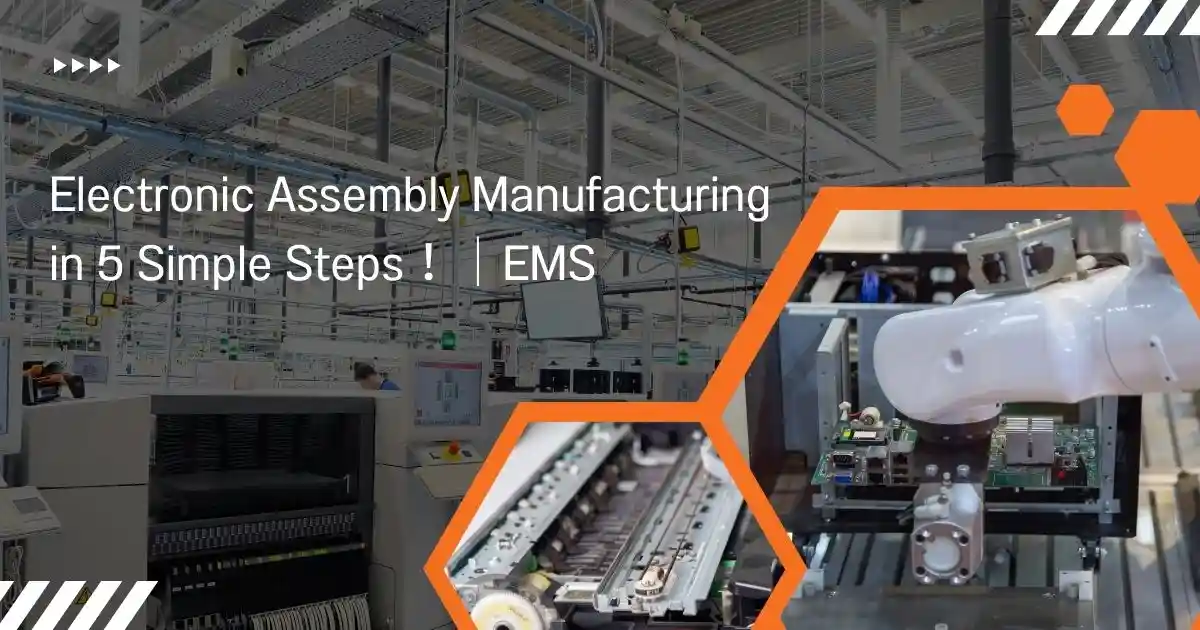
Electronic assembly is a critical manufacturing process that involves mounting electronic components onto printed circuit boards (PCB) to create functional electronic devices.
This article will introduce the various steps and types of electronic assembly services, along with tips on how to choose the right partner.
Helping you to gain a comprehensive understanding of each stage from design to final assembly, and most importantly, learn how to identify a trusted partner.
🏭Further reading :How to find Plastic Injection Plant?
What Is The Meaning Of Electronic Assembly?
As mentioned earlier, electronic assembly refers to the process of mounting various electronic components onto PCB to enable the functionality of electronic devices.This involves precise component installation, soldering, and quality control.
The common techniques include SMT (Surface Mount Technology), PTH (Plated Through-Hole), and hybrid technology (Combining SMT and PTH).
Additionally, soldering techniques (such as reflow soldering and wave soldering) and testing methods (like function and stress testing) can also help ensure assembly quality.
High quality electronic assembly not only guarantees product reliability but also enhances performance and reduces maintenance costs.
Electronic assembly services can be categorized into the following types:
- High volume assembly: Ideal for mass production, often supported by automated equipment.
- Low volume assembly: Suitable for small batch, high precision electronic products with strict quality requirements.
- Custom assembly: Customized solutions for electronic products with special requirements.
How does electronic assembly services process work?
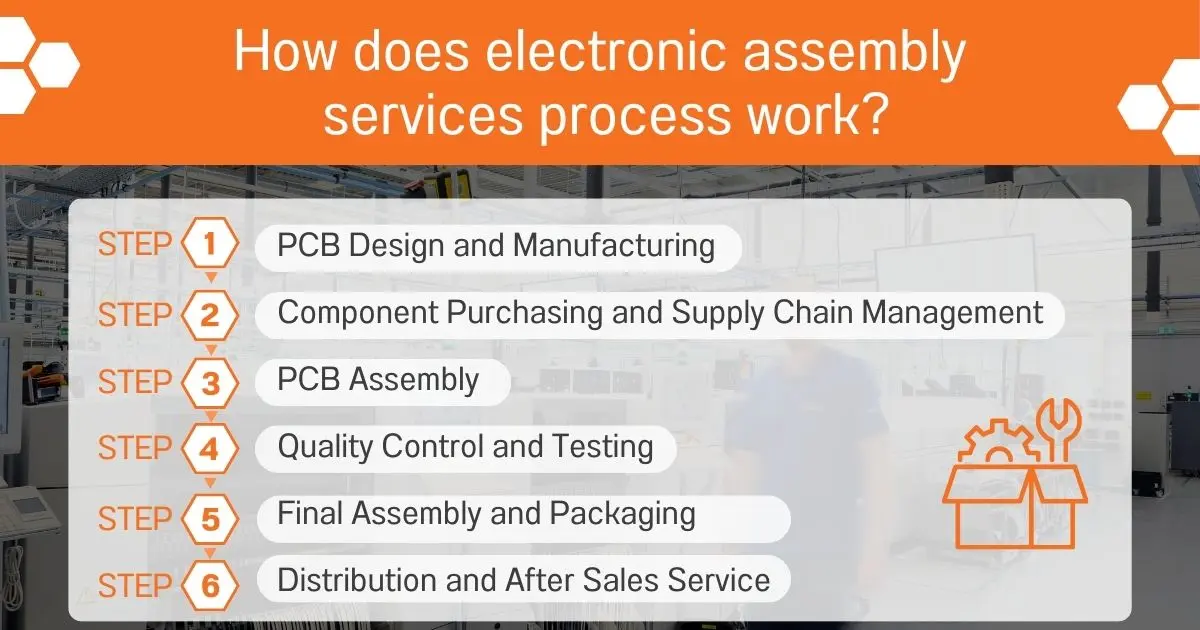
Electronic assembly services are a meticulous and well organized manufacturing process from designing to the final product, which ensures the functionality and reliability of the electronic devices.
Next, will be the main steps of electronic assembly services, including PCB design and manufacturing, component purchasing and supply chain management, PCB assembly, quality control and testing, as well as distribution and after sales service.
PCB Design and Manufacturing
Starting with circuit schematic design, which illustrates the connections between electronic components, followed by PCB layout design to determine the specific placement of components on the board.
Then after completing the design, will produce a prototype and do the testing to ensure it meets the expected performance standards.
Once successfully validated, mass production of PCB begins, with the PCB boards manufactured according to design specifications, preparing for the follow-up component installation.
Component Purchasing and Supply Chain Management
Based on the design requirements, the assembly company will source the necessary electronic components from clients or external suppliers.
The focus at this stage is to ensure timely purchasing of components to avoid disruptions in the production process.
In some special cases, when custom or hard to find components are needed, the assembly company may collaborate with suppliers or even arrange for component customization.
PCB Assembly
This process can use one of the previously mentioned technologies; SMT, PTH, or hybrid methods.
SMT is an automated method suitable for installing high density electronic components, offering efficiency and precision.PTH is suitable for components requiring strong mechanical connections.
Components are inserted into PCB holes either manually or automatically and then soldered. Hybrid technology combines the advantages of SMT and PTH, making it ideal for complex PCB requiring both technologies, offering greater flexibility and precision to accommodate various component needs.
Quality Control and Testing
Functional testing ensures that electronic components operate correctly, while stress testing evaluates the durability of the PCB under different conditions.
To ensure there is no defect in the assembly process, manufacturers utilize advanced inspection technologies such as Automated Optical Inspection (AOI) and X-ray inspection, finding and solving the problem as early as possible.
Final Assembly and Packaging
Once PCB assembly and testing are completed, the process moves to the final assembly stage, where all components (such as circuit boards, enclosures, and connectors) are assembled into complete or semi-finished products. This stage includes:
- Enclosure Installation:
Selecting suitable plastic or metal enclosures to ensure the product’s appearance, durability, and structural strength, followed by secure installation.This also includes installing display screens, adjusting buttons, and aligning connectors to ensure the assembled product meets design specifications.
- Packaging Operations:
Based on market requirements, products are placed into different types of packaging, such as color boxes, paper cards, or gift boxes, to ensure safety and aesthetics during transportation and sales.
- Labeling and Accessory Arrangement:
Includes organizing user manuals, arranging accessories, and attaching barcode labels to ensure the product is ready for distribution and sales.
Distribution and After Sales Service
After the final assembly and packaging are completed, the product enters the distribution phase, ensuring smooth delivery to customers while providing necessary after-sales support.
The optimal transportation method (such as land, air, or sea) should be planned, and inventory management systems should be used to monitor stock levels and shipment status to meet market demand.
During the delivery process, timely shipment and quality inspection must be ensured, along with prompt handling of any potential issues.
After-sales service includes technical support, troubleshooting, and maintenance to ensure product stability. Customer feedback is also used to improve future designs and production.
For companies focused on sustainability, establishing a recycling system can be beneficial. Offering product recycling or upgrade services can extend product life cycles, reduce electronic waste, and enhance the company’s competitiveness in sustainable development.
For products designed and manufactured by Hung Yih Technology or Hsin Hung Yih Plastic, we offer comprehensive turnkey service.
These cover the internal “heart”—PCB design and manufacturing—and the external “skin”—integrated solutions for mechanical plastic and metal case.
The value of this integrated service lies in ensuring precise compatibility between electronic components and outer case, which enhance protection, durability, and aesthetics.
Additionally, we provide full after sales service, from internal circuit repairs to outer case maintenance, ensuring stable performance and worry-free use for customers.
How to choose the right type of electronic assembly services?
When selecting suitable electronic assembly services, businesses should decide based on their specific needs. Different service models offer varying levels of support and solutions:
Contract Electronics Assembly
Contract electronic assembly focuses on providing assembly services for Original Equipment Manufacturers (OEM), meaning that the assembly company is only responsible for mounting electronic components onto PCB, while other tasks such as product development are handled by the OEM.
This service type is ideal for businesses that only require reliable assembly without the need for additional design or prototyping.
Original Design Manufacturing (ODM)
ODM not only provide component assembly, but also includes product design and development.
Specifically, the assembly provider acts as both designer and manufacturer, offering customers an integrated solution from concept design to final product manufacturing.
This service is suitable for companies seeking a one stop solution from concept development to finished product.
Electronics Manufacturing Services (EMS)
EMS provides a more comprehensive solution, including design, research and development, component purchasing, outer protective case design, and a complete electronic assembly manufacturing.
EMS handles every stage of the manufacturing process, from component purchasing to final assembly and testing, ensuring high quality product delivery.
This service is suitable for companies that require highly integrated solutions and need to manage complex electronic product development and manufacturing.
I believe that if a company requires comprehensive support, including design and production, choosing EMS is the ideal option, since it offers professional manufacturing capabilities and thorough after sales services, ensuring high quality products and efficient production processes
How to choose the suitable electronic assembly companies?
The three service types mentioned above can be evaluated using the following criteria to better assess whether a company meets your needs.
Production Capabilities
- Ensure the supplier has advanced production equipment and sufficient technical capabilities.
- Ability to handle large scale production or small batch customized demands.
- Capability to manage high density assembly or complex designs.
Quality Control
- Understand the supplier’s quality assurance measures.
- Verify whether they have comprehensive testing equipment and standardized inspection processes to ensure every PCB assembly meets industry requirements and able to maintain stable performance.
Delivery Lead Time
- Assess the supplier’s production capacity and delivery schedule.
- Ensure the ability to deliver products quickly and on time.
After Sales Service
- Provide comprehensive technical support and problem solving solutions.
- Offer necessary support after product delivery and effectively address issues when they arise.
I have sort out some questions that you may consider asking to evaluate your potential partner’s expertise:
- What types of PCB assemblies can you handle?
- What are your quality assurance measures?
- Are you able to provide sample assemblies and small batch production?
- How are your delivery lead times and project management capabilities?
- What after sales services and support do you offer?
🏭Further reading : How to choose Injection Mold Tooling?
High quality electronic assembly equipment | Hung Yih Technology
If you prefer not to compare various manufacturers using the step by step mentioned above, you may consider Hung Yih Technology or Hsin Hung Yih Plastic.
f you prefer not to compare various manufacturers using the step by step mentioned above, you may consider Hung Yih Technology or Hsin Hung Yih Plastic.
As a professional electronic assembly equipment provider, we not only offer advanced complete assembly integration capabilities, but also a one-stop solutions.
Our services cover various technologies, including SMT, SMD, and manual assembly, catering to diverse assembly requirements. Moreover, all processes are seamlessly integrated for maximum efficiency.
Why is electronic assembly certification very important?

Certification Standards in Electronic Assembly
Common certification standards include ISO 9001 and IPC-A-610, which require companies to maintain strict quality control and follow international standards from the design, manufacturing, and to assembly processes:
ISO 9001 Certification focuses on quality management systems, ensuring that companies maintain consistent standards across all operations.
IPC-A-610 is a standard specifically for electronic assembly quality, with an emphasis on component installation, soldering quality, and repair-ability to ensure product stability and reliability.
How does certification enhance your business reputation?
Companies with certifications are often be considered as having high standards in management and production, capable of delivering more reliable and superior products.
These certifications not only strengthen trust among existing customers but also attract potential partners and new clients. In simple terms, it help businesses gain trust in the global market and unlock more business opportunities.
Moreover, they are crucial for entering high-end markets or collaborating with international corporations. So, certifications not only serve as a quality guarantee, but also a valuable asset for businesses to establish and grow within the industry.
🏭Further reading :Why do we need custom injection molding?
What is electronic assembly? | FAQ
Meets the electronic assembly certification | Hung Yih Technology
After reading this article, if you’re looking for an EMS provider with professional certifications, we recommend Hsin Hung Yih Technology, or Hsin Hung Yih Plastic.
We offer comprehensive support for technologies including SMT, SMD, and manual assembly, focusing on complete device assembly and integration services rather than just simple component placement.
With advanced production equipment and technology, we provide efficient and high quality assembly solutions to meet various customer needs.
Additionally, we place great focus on environmental requirements. All production processes meets the environmental standards, striving to offer customers efficient services aligned with sustainable development while ensuring international quality products.

I got a bachelor’s degree in Mass Communication. I freelance in my spare time, particularly enjoying the challenge of writing about B2B and other complex industries.
Before taking on assignments, I like to have discussions with industry professionals—not only to enrich my own knowledge but also to craft more practical and lesser-known insights. That’s what gives me a true sense of accomplishment!
My goal is to write in a clear and approachable way, making professional content easy to understand for general readers.
If you’re interested in the B2B industry, feel free to reach out!