

PCB full form is Printed Circuit Board—a bare board with copper traces but no parts.
PCBA manufacturing meaning refers to the full assembly flow that turns a PCB into a working module through SMT/THT, soldering and test.
If you’re searching for PCB meaning vs PCBA meaning, think of PCB as the structure and PCBA as the functional electronics built on top.
What is PCB?
Before discussing PCBA, it’s important to understand PCB because it is the fundamental structure of all electronic devices.
Basically, a PCB (Printed Circuit Board) is a board used to support electronic components and connect them to each other.
It is usually made out of insulating material, with conductive copper traces etched on the surface. These traces connect various components into a complete circuit according to the design.
PCB Meaning
The PCB itself contains no components and has limited functionality on its own, but it is the key to making the entire circuit work.
PCBs are often green because they are coated with a protective solder mask, and component labels are printed on the surface for easier assembly and maintenance.
Types of PCBs
- Single layer boards: The conductive traces are only on one side, used for simple electronic products.
- Double layer boards: Conductive traces on both sides, allowing for more compact circuit designs.
- Multi-layer boards: Three or more layers, used in complex devices such as computers and smartphones.
- Flexible and rigid-flex boards: Can bend, suitable for designs with limited space, such as wearable devices.
Applications in Electronics
Almost all electronic products, from everyday items like phones and TVs to medical equipment and automotive electronics, rely on PCBs.
PCBs provide fixed positions for components and ensure stable transmission of signals and power.
What is PCBA?

After understanding PCB as the fundamental platform of electronic devices, next we introduce PCBA — the key stage where the circuit board gains its actual functionality.
You can think of the PCB as a blank board that is not yet “activated,” while the PCBA is the finished product with all necessary electronic components added.
PCBA Meaning
PCBA stands for “Printed Circuit Board Assembly” and can mean two things:
One, is the completed assembly product, where all components are soldered and the circuit board can perform its designed functions. And two, is the assembly process of mounting components onto the PCB itself.
Depending on application needs and component types, manufacturers use different assembly technologies, the most common being:
- SMT: Electronic components are directly mounted on the PCB surface. Suitable for characteristics such as high density, miniaturized products and highly automated.
- THT: Component pins are inserted into pre-drilled holes and soldered, suitable for applications requiring high strength and vibration resistance.
Key Components of a PCBA
- Main PCB Body: Provides structural support and electrical pathways, it is the foundation for all components.
- Electronic Components: Includes active and passive parts such as resistors, capacitors, diodes, ICs, connectors, etc., which are all core to realize the board’s functions.
- Assembly Techniques: Based on design requirements, assembly can use SMT, THT, or a combination of both.
- Soldering Processes: Such as reflow soldering, wave soldering, or manual soldering to ensure components are securely connected and conduct electricity properly.
- Testing and Inspection: Including AOI, X-ray inspection, functional testing, etc., to ensure the PCBA operates correctly.
PCBA vs PCB
A “PCB only” board means the bare laminate with copper traces, while a PCBA includes mounted components, soldering and testing.
This “PCBA vs PCB” distinction is critical in procurement: PCB is used for layout and cost estimation, while PCBA is the actual electrical module delivered to your product line.
|
Item |
PCB |
PCBA |
|
Definition |
Bare board with circuit pattern only |
Fully assembled functional board with components |
|
Functions |
Cannot be used directly |
Electronic module ready for application |
|
Production Difficulty |
Relatively simple |
Involves multiple processes and quality control |
|
Packaging Method |
Usually vacuum-packed |
Requires anti-static, compartmentalized packaging to protect components |
|
Costs |
Lower |
Higher, depending on assembly complexity |
From this, it is clear that the PCB is the hardware framework, while the PCBA is the soul that brings it to life. Both are indispensable.
In consumer electronics, PCBA drives smartphones and laptops. In automotive electronics, PCBA meaning car refers to assemblies inside ECUs, ADAS, and infotainment systems—where vibration resistance, wide temperature tolerance, and AEC-Q qualification are required.
What is the Difference between PCB and PCBA?
Although PCB and PCBA are closely related, they have fundamental differences in design purpose, manufacturing complexity, cost structure, and application scenarios.
Understanding these differences clearly not only helps engineering teams make correct plans during development but also assists procurement and product managers in making well-informed decisions when selecting manufacturing services or evaluating suppliers.
Function and Purpose
PCB is a “bare board,” like the foundation of a circuit, with copper traces and holes but no active function itself.
While PCBA is the functional circuit board with all electronic components installed on this foundation, ready to be powered on and perform.
Application Scope
PCB is simply a “board ready to be used,” but not functional on its own. PCBA is the true working core of all electronic products.
Whether in smartphones, laptops, automotive systems, medical devices, or industrial controllers, the functional unit in operation is always the PCBA, not the empty PCB.
Manufacturing Process
Manufacturing a PCB is similar to a printing technology, copper foil circuits are “printed” onto the board.
PCBA involves “pasting” components onto the board like building blocks, followed by soldering and testing to create a working module.
Cost and Complexity
PCB itself is inexpensive with standardized, repeatable manufacturing processes. But, PCBA involves component procurement, manual or automated assembly, and quality inspection, which significantly increases labor and technical costs.
The more complex the board (such as multi-layer, BGA packages), the higher the assembly difficulty. A single soldering defect can scrap the entire board.
🏭Further reading: Looking for Custom PCB? Check this out!
Lead Time
PCBs alone may be delivered within a few days, but PCBA lead times must consider component sourcing, scheduling, soldering, and testing. Delays in components or production bottlenecks can extend delivery times by several times.
Especially when components are scarce or customized, PCBA lead times are far more variable than the PCB production itself.
Repair and Maintenance
If a PCB is damaged, usually due to board cracking or broken traces, it is often scrapped. While PCBA allows for individual component replacement or re-soldering, offering much greater repair flexibility.
Although PCBA repair requires higher technical skills, it is more likely to save the whole circuit board without full replacement.
PCBA Manufacturing Process
Whether it’s advanced industrial control equipment, medical electronics, or consumer devices, a stable and consistent PCBA manufacturing process directly affects product quality, yield, and time-to-market.
Below is a concise overview of the main workflow in PCBA manufacturing, from design and component placement to soldering and testing.
Understanding these stages helps companies better evaluate supplier capabilities, optimize product development workflows, and strengthen quality control, ultimately reducing risk and improving delivery performance.
Circuit Design and Layout Preparation
The first step is transforming the circuit concept into a practical design that can be manufactured.
Engineers will first create a schematic to define the connections between components, then converts it into a PCB layout. This phase also includes designing the stackup, signal routing, and manufacturing tolerances.
Component Configuration and Board Planning
Before physical manufacturing, design rules must be set, such as component spacing, trace widths, and thermal conditions. By using a design software to arrange component placement and determine drilling positions (such as for vias and mounting holes), to facilitate subsequent manufacturing steps.
Automated Component Placement
Once the PCB is fabricated, SMT machines place components precisely at designated positions. This automation technology is ideal for densely packed components, helping reduce product size and improve production efficiency.
🏭Further reading: What is SMT?
Leaded Component Insertion (If Required)
For boards with pins or wires components (such as connectors or large capacitors), manual soldering or wave soldering is used for installation.
This through-hole technology remains widely applied where mechanical strength and heat resistance are critical.
Soldering and Thermal Bonding
Using surface mount components pass through a reflow oven where solder paste melts and solidifies, which will form secure joints.
Through-hole components undergo additional soldering steps, which may include specialized thermal treatments or manual operations.
Visual Inspection and Functional Testing
A reliable PCBA test program covers SPI, AOI, ICT, and functional test to catch solder defects and ensure performance. In electrical engineering, PCBA meaning electrical describes a complete module under power validation.
To avoid hidden failures, strict ESD meaning controls—such as ionization, wrist straps, and EPA zoning—are enforced during handling. These checks prevent short circuits, cold joints, and other electrical defects.
🏭Further reading: Electronic Assembly Manufacturing in 5 Simple Steps!|EMS
Choosing the Right PCBA Manufacturer
If you are preparing to start PCBA production, choosing the right manufacturer is essential!
Understanding the supplier’s lead time, cost, technical capabilities, and support services will help your product launch more smoothly to the market.
Here are some key points to keep in mind:
Lead Time and Cost
In a competitive market, delays in delivery may cause missed business opportunities.
An ideal manufacturer not only offers reasonable pricing but also guarantees on-time delivery, preventing delays in subsequent operations.
It is recommended to ask about their average lead time, availability of expedited options, and possible cost variations before making the decision.
Capabilities and Certifications
Check whether the manufacturer holds relevant certifications such as ISO 9001 or IPC-A-610 standards, these are important indicators of manufacturing capability.
These certifications demonstrate that they have strict quality management processes and reliable manufacturing control, enabling them to produce products that meet industrial standards. Additionally, the manufacturer’s expertise in SMT and THT technologies will determine if they can handle your product’s special requirements.
Engineering Support
It is inevitable to encounter some problems during design and production. Having a professional engineering team to assist will make the process smoother, avoid trial-and-error by yourself, which save you time.
PCBA Prototyping Services
Receiving samples quickly is very important for product development to allow early testing and adjustments to avoid discovering problems during large scale production.
A good manufacturer will offer suggestions during the design phase to help optimize board layout and component selection, reducing future errors. They will also provide quick assistance during production to resolve issues and ensure smooth mass production.
Reliable PCBA Manufacturing Services for B2B Clients
Are you looking for a PCBA partner who delivers quality, flexibility, and on-time delivery?
Hsin Hung Yih Technolog is your trusted one-stop PCBA manufacturing service provider, specializing in small batch, diverse, and time sensitive production needs.
We not only offer assembly services but also component procurement, DFM support, multi-stage inspection, and functional testing, all while ensuring fast turnaround times. Our services are widely applied across automotive electronics, medical devices, industrial control systems, and high-end consumer electronics.
Our advantages include:
- Flexible production capabilities, can efficiently handle low-volume, high-mix orders while balancing cost and efficiency.
- Professional technical expertise, combining SMT and THT processes to ensure both precision and reliability.
- Diverse cooperation modes, whether it is turnkey solutions, consignment, or partial outsourcing, we customize to your needs.
- Transparent communication and rapid response, proactively solving issues to ensure every batch meets your quality standards.
Hsin Hung Yih Technology offers a wide range of CNC machines and rich machining experience, enabling us to provide complete solutions based on customer needs.
From prototyping and trial production to large scale manufacturing, we have the ability to handle it all. Whether it is precision parts, small batch customized products, or large volume production projects, we can flexibly adapt to meet each stage’s high quality standards.
We don’t just deliver PCBA products, but we also bring confidence and reliability to your supply chain. Whether for new product development or mass production scaling, we carefully and precisely turn your ideas into reality.
Let’s join hands to build the next generation of electronic products, contact us today!
Benefits of PCBA
According to data from Global Market Insights Inc., the global PCBA market size exceeded US$90 billion in 2023, and is expected to grow at a compound annual growth rate of about 5% from 2024 to 2032.
The Asia-Pacific region (including China, Japan, South Korea, and Taiwan) accounts for over 25% of the global market share, with Taiwan playing a key role thanks to its mature technology and complete supply chain.
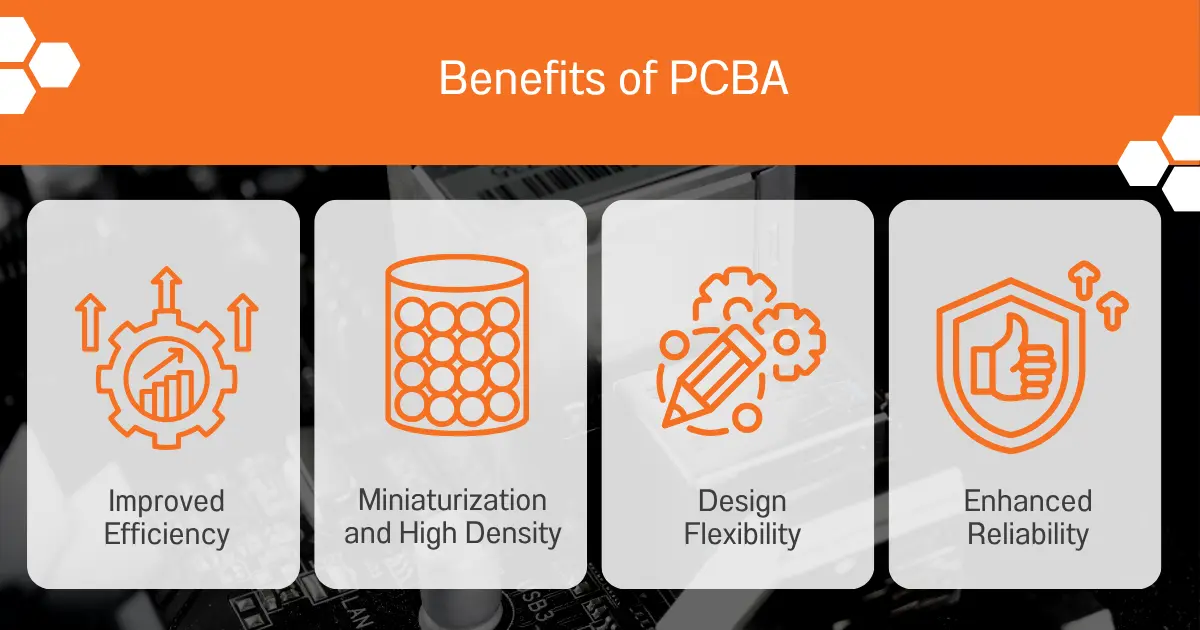
In this context, understanding the advantages of PCBA is especially important for product design and manufacturing decisions. Below are four core benefits of PCBA that explain how it enhances the competitiveness of electronic products.
Improved Efficiency
Since PCBA manufacturing mainly uses automated production equipment, with strict control from component placement, SMT, soldering, and inspection, it greatly reduces human errors and production time, ensuring consistent quality for each batch.
This efficient process not only lowers production costs but also enables rapid market response, accelerating product time-to-market to meet the fast pace of the competitive electronics industry.
Miniaturization and High Density
As smart devices and IoT products become increasingly popular, there is a growing demand for compact but complex functionalities.
PCBA uses SMT and multi-layer board designs to densely pack many components, achieving miniaturized yet high-performance electronic systems. This enables consumer electronics, medical devices, and industrial applications to deliver higher performance within limited space.
Design Flexibility
Whether it is communication equipment requiring high-speed signal integrity or industrial control systems demanding durability and safety, PCBA allows component and routing adjustments according to design needs, effectively reducing product development risks and costs.
Enhanced Reliability
Strict implementation of soldering quality inspection and functional testing during manufacturing effectively reduces soldering defects and failure rates.
High reliability PCBA forms the foundation for stable operation in critical fields such as medical, automotive, and industrial products, ensuring the safety and longer life of terminal devices.
What is PCBA | FAQ
High Capacity PCBA Process | Hsin Hung Yih Technology
Choosing a high capacity PCBA process not only ensures production efficiency but also improves product quality and delivery time stability.
Hsin Hung Yih Technology combines advanced equipment with strict quality control to provide customers with fast and reliable assembly services, to meet the diverse needs from prototypes to large volume production.
We value environmental sustainability, actively promoting carbon reduction measures and carbon footprint management, aiming to minimize environmental impact during manufacturing. Through flexible design optimization and rapid engineering support, we help customers reduce costs and risks, ensuring every circuit board meets the highest quality standards.
Choosing Hsin Hung Yih Technology means selecting a reliable, efficient, and socially responsible partner to help your products successfully reach the market while achieving green manufacturing goals.
Ready to elevate your PCBA quality? Partner with us now!

I got a bachelor’s degree in Mass Communication. I freelance in my spare time, particularly enjoying the challenge of writing about B2B and other complex industries.
Before taking on assignments, I like to have discussions with industry professionals—not only to enrich my own knowledge but also to craft more practical and lesser-known insights. That’s what gives me a true sense of accomplishment!
My goal is to write in a clear and approachable way, making professional content easy to understand for general readers.
If you’re interested in the B2B industry, feel free to reach out!